
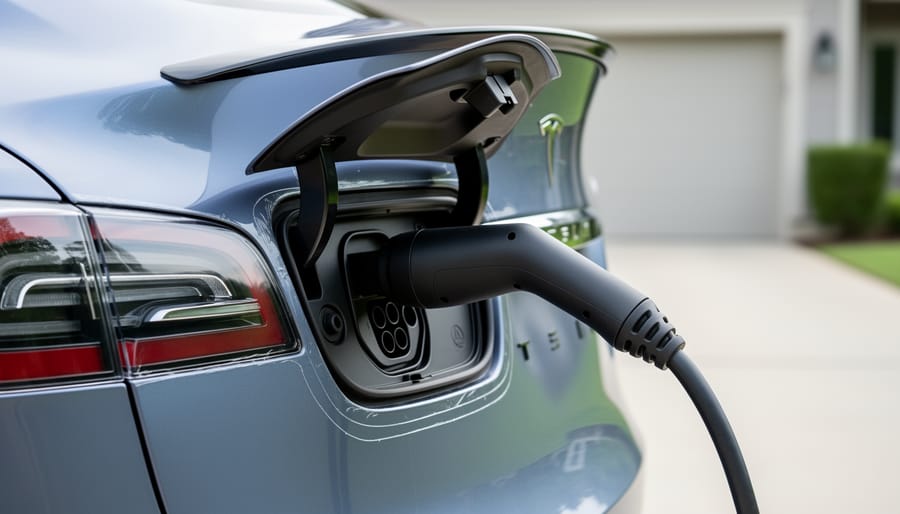
Why Your Tesla or BYD Needs PPF Around Every Charging Port
EV charging protection film (PPF) is a clear, self-healing urethane layer applied around your vehicle’s charging port to prevent paint chips, scratches, and scuffing caused by repeated cable insertion and metal-on-metal contact. For Tesla and BYD owners in 2026, this targeted solution addresses one of the most common cosmetic issues plaguing electric vehicles: premature paint damage in a high-contact area that sees daily use.
The problem is straightforward. Every time you plug in, the charging cable’s metal connector risks scraping against painted surfaces. Over months of ownership, this repetitive action creates visible wear patterns, paint chips, and clearcoat damage that traditional waxes or sealants can’t prevent. Tesla Model 3 and Model Y owners have documented this issue extensively, particularly around the rear quarter panel where the charge port door opens. BYD models face similar challenges, though port placement varies across their Atto 3, Seal, and Dolphin lineups.
Professional-grade PPF designed for charging ports typically ranges from 6 to 8 mils in thickness and features hydrophobic properties that repel water, dirt, and contaminants. The film’s self-healing topcoat allows minor scratches to disappear with heat exposure, maintaining a factory-fresh appearance. Installation takes 30 to 45 minutes when performed by a certified technician, though pre-cut DIY kits have become increasingly popular for cost-conscious owners willing to invest an hour of careful application.
The economic case is compelling. Repainting a charging port area professionally costs $400 to $800, while quality PPF installation ranges from $150 to $300 and lasts five to seven years. For vehicles approaching lease return or resale, this preventive measure protects residual value. If you’re serious about paint protection for your Tesla or BYD, understanding the specific requirements of each brand ensures optimal coverage and longevity.
The Charging Port Damage Problem EV Owners Face
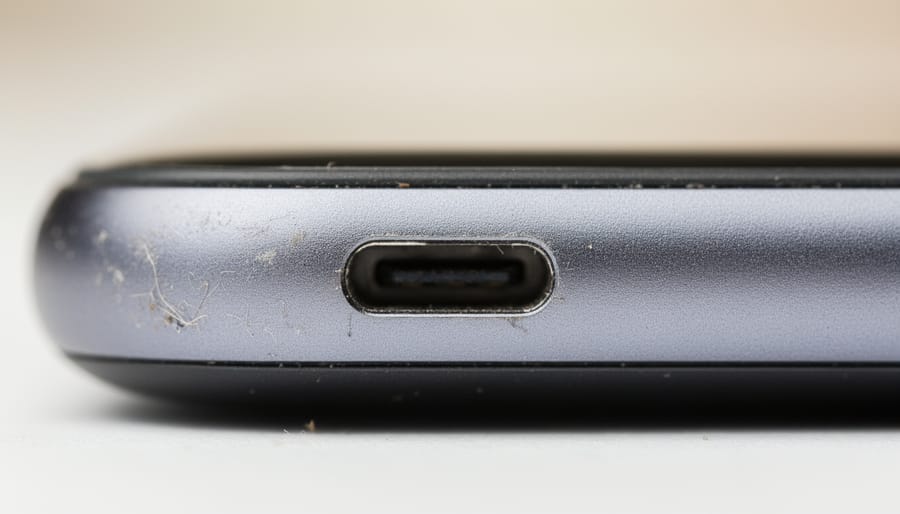
Every time you plug in your Tesla or BYD, you’re creating friction between the charging cable connector and the paint around your charging port. That contact point, repeated hundreds or thousands of times over ownership, gradually wears down the factory finish in predictable patterns.
The damage starts as barely visible micro-scratches where the cable housing rubs against the body panel during insertion and removal. Most drivers don’t align the connector perfectly on every charge, especially at night or when rushing. Each misalignment drags the hard plastic or metal connector across painted surfaces. Within six months of daily charging, these micro-abrasions accumulate into visible scuff marks that catch light differently than the surrounding paint.
Paint chips develop at stress points where the connector edge impacts the port surround. The repetitive contact creates pressure concentrations that eventually crack the paint’s top layer. Once the clear coat breaks, the underlying base coat becomes vulnerable to moisture, road salt, and oxidation. What begins as a tiny chip can spread outward through delamination, particularly on vehicles with multi-layer paint systems.
Seasonal temperature fluctuations intensify this degradation. Paint contracts in freezing conditions and expands in heat. When you’re charging in winter, brittle paint is more prone to chipping from cable contact. Summer heat softens paint, making it susceptible to scuffing and imprinting from prolonged cable pressure during long charging sessions. This thermal cycling weakens paint adhesion around high-contact zones faster than on protected body panels.
Fleet vehicles and cars used for rideshare face accelerated wear. A Tesla Model 3 charging twice daily accumulates 730 plug-in cycles annually, more than triple the wear of a typical private vehicle. Fast charging compounds the problem because DC cables are heavier and stiffer than home charging cables, requiring more force to position and creating greater surface friction.
The charging port area also collects contaminants. Dust, grit, and road debris settle around the port opening, acting as abrasive particles between the cable and paint. Public charging stations in parking structures or roadside locations expose vehicles to industrial fallout, brake dust, and environmental pollutants that etch into damaged paint faster than intact surfaces.
This damage isn’t merely cosmetic. Dealerships and private buyers scrutinize charging port condition during resale inspections, viewing wear patterns as indicators of overall vehicle care and usage intensity.
What Paint Protection Film Actually Protects
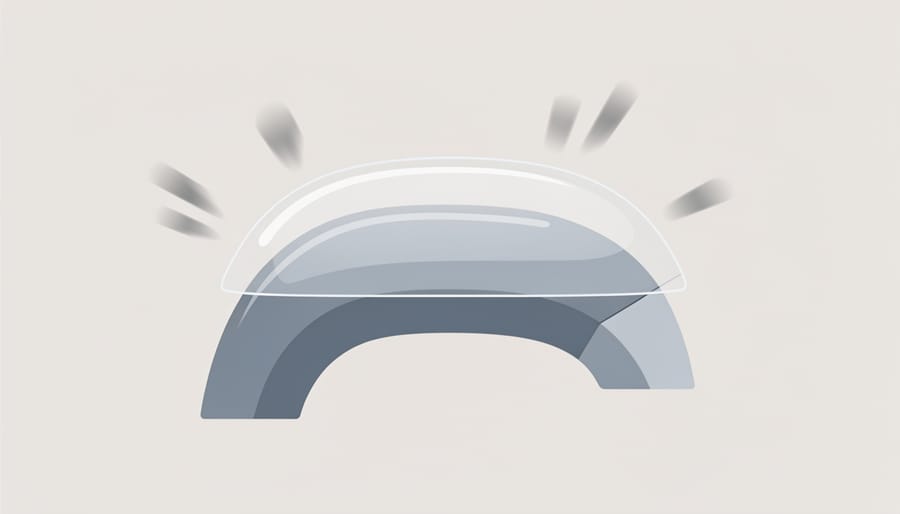
Paint protection film functions as a transparent shield composed of thermoplastic urethane, a material originally developed for military helicopter blade protection. Modern automotive PPF typically consists of multiple layers: a clear coat with self-healing properties, a urethane base layer providing impact absorption, and an acrylic adhesive designed for permanent yet damage-free bonding to automotive paint.
The self-healing characteristic represents PPF’s most distinctive feature. When the film surface sustains minor scratches or swirl marks, exposure to heat triggers the urethane polymers to return to their original molecular structure. This occurs naturally in sunlight at temperatures above 60°F, or more rapidly when parked in direct sun or after washing with warm water. Around charging ports, this means cable contact marks that would permanently mar bare paint simply disappear from protected surfaces within hours.
Optical clarity matters because any film protecting your EV’s exterior must remain invisible while performing its function. Premium PPF products maintain better than 98% light transmission and resist yellowing for their entire warranty period, typically 5-10 years. The film should be indistinguishable from the factory paint surface when properly installed, preserving your Tesla or BYD’s appearance.
PPF excels at defending against multiple threat categories relevant to charging environments. Physical abrasion resistance handles the repeated scraping from charging cable connectors, including the heavier industrial-grade cables found at commercial stations. Chemical protection matters at public charging locations where bird droppings, tree sap, acid rain, and spilled fluids contact the vehicle surface during extended charging sessions. UV resistance prevents paint oxidation and fading in the exact areas where sunlight exposure concentrates while parked at outdoor charging stations. Environmental contaminants like road salt, brake dust, and industrial fallout also bond to bare paint but wash cleanly from PPF-protected surfaces without etching the finish underneath.
Tesla-Specific PPF Considerations
Tesla’s paint system differs fundamentally from traditional automotive finishes, using a water-based multi-coat process that prioritizes environmental compliance over durability. This creates a softer clear coat layer that scratches more easily than solvent-based alternatives, making the charging port area particularly vulnerable to daily wear. The company’s rapid production scaling has also led to inconsistent paint thickness across factory locations, with some owners reporting variations even between body panels on the same vehicle.
Color selection significantly impacts how quickly charging port damage becomes visible. Pearl White Multi-Coat shows scratches and scuffs most dramatically due to its layered metallic structure, where deeper abrasions expose contrasting underlayers. Midnight Silver Metallic similarly telegraphs damage through its reflective finish. Red Multi-Coat and the newer Quicksilver and Midnight Cherry Red options face additional challenges from their complex pigment systems, which cannot be touched up effectively once compromised. Black paint hides minor scuffs initially but develops a spider-web pattern of fine scratches that catches light at certain angles.
| Tesla Model | Charging Port Location | Vulnerable Area | Recommended PPF Coverage |
|---|---|---|---|
| Model 3/Y | Driver rear quarter panel | 4-inch radius around port | 6×8 inch pre-cut section |
| Model S/X | Driver rear quarter panel | 5-inch radius, curved surface | 8×10 inch custom-cut piece |
| Cybertruck | Driver rear bed panel | Stainless steel (minimal risk) | Not typically required |
Model 3 and Model Y share identical charging port positioning on the driver-side rear quarter panel, sitting directly behind the rear door handle. This location creates a natural hand-rest area where owners inadvertently touch the paint while manipulating the charge cable, leaving fingerprint oils that attract dirt and grime. The quarter panel’s gentle curve requires PPF installers to use heat and stretching techniques to avoid lifting edges, making professional installation worthwhile despite the small coverage area.
Model S and X present more challenging installation scenarios. Their charging ports occupy similar rear quarter locations but feature more pronounced body contours and wider spacing between the port and body lines. Older Model S vehicles (pre-2016) used a different port door mechanism that created additional contact points, requiring slightly larger PPF coverage zones to protect adjacent surfaces.
The Cybertruck represents a complete departure. Its unpainted stainless steel body eliminates traditional paint protection concerns, though some owners apply PPF to prevent fingerprinting and maintain the factory finish appearance. The charging port sits lower on the bed panel, changing the ergonomics of cable connection and reducing incidental contact with surrounding surfaces.
BYD-Specific PPF Considerations
BYD vehicles present distinct PPF considerations shaped by the company’s vertical integration approach to manufacturing. Unlike Tesla’s multi-layer paint process, BYD applies a more traditional automotive coating system across most models, though quality consistency varies significantly by production facility and target market.
The Seal and Han models feature charging ports positioned on the rear quarter panel, creating a vulnerable surface that extends beyond the immediate port area. Cable drape patterns during charging sessions cause contact points along the bodywork that differ from Tesla’s front-fender placement. This rear-quarter location means the PPF application must account for curves and body lines that professional installers sometimes overlook when focusing solely on the port recess itself.
BYD’s Atto 3 and Dolphin employ charging ports integrated into the front grille assembly, similar to some European EV designs. This forward placement reduces cable-contact damage to painted surfaces but introduces different protection requirements where the charging cable rests against bumper edges and lower fascia panels during use. The textured plastic trim surrounding these ports can trap dirt and debris that gets dragged across adjacent painted areas.
Paint hardness testing reveals BYD’s factory coatings sit somewhere between Tesla’s notoriously soft finishes and traditional combustion vehicle standards. European-market BYD vehicles generally receive superior paint application compared to early Chinese domestic models, though recent production shows narrowing quality gaps. The Seal’s blade battery mounting creates structural reinforcement beneath charging port locations, which minimizes panel flex during cable insertion but doesn’t prevent surface-level abrasion from repeated contact.
Color-specific vulnerabilities appear most pronounced in BYD’s lighter metallic shades, where micro-scratches show through the base coat more readily than on solid darker colors. Fleet operators using BYD vehicles for ride-sharing report accelerated wear patterns around charging infrastructure, making PPF protection particularly cost-effective for high-utilization scenarios.
Professional Installation vs. DIY Application
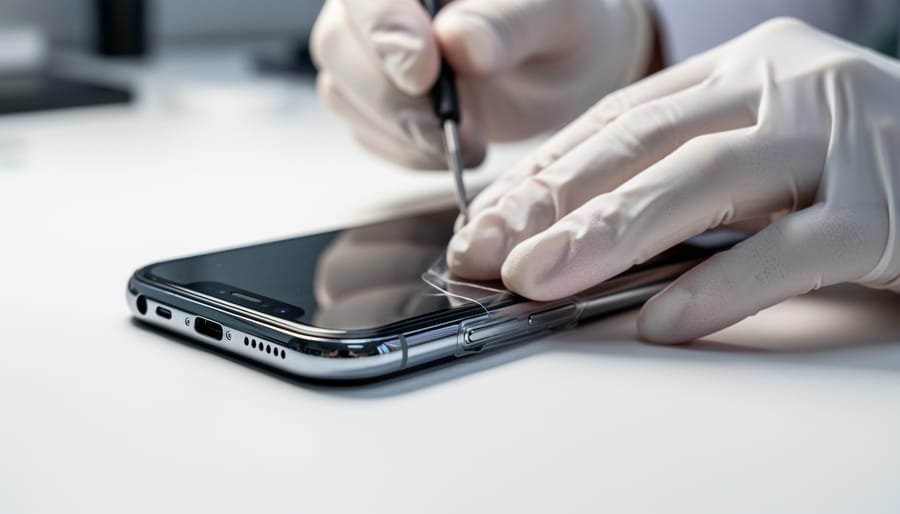
Professional installation remains the gold standard for charging port PPF application, particularly around the contoured surfaces surrounding Tesla and BYD charging receptacles. Certified installers use computer-cut templates specific to each vehicle model, ensuring precise coverage that extends 2-3 inches beyond the port opening without overlapping onto adjacent panels. Their work includes meticulous edge sealing, a critical step that prevents moisture intrusion and premature lifting in high-use areas, plus surface preparation that removes factory wax residues and contaminants invisible to untrained eyes.
The skill gap between professional and amateur installation becomes apparent in how the film conforms to the three-dimensional curves around charging ports. Experienced technicians use heat guns calibrated to exact temperatures (typically 160-180°F) that activate the film’s adhesive without causing distortion, stretching the material gradually to eliminate air pockets and achieve optical clarity. They also apply slip solutions in controlled amounts, allowing repositioning during installation without compromising adhesion strength once the film cures.
Professional Installation Pros
- Warranty coverage protects against defects and installation failures for 2-5 years
- Precision-cut patterns ensure complete coverage without visible seams or gaps
- Professional surface preparation and edge sealing prevent premature failure
- Heat application expertise ensures proper adhesion on complex curves
Professional Installation Cons
- Higher upfront cost ranging from $150-400 for charging port areas alone
- Appointment scheduling required, adding inconvenience compared to at-home application
- Quality varies significantly between installers without standardized certification
DIY Application Pros
- Lower material costs with pre-cut kits available for $40-80
- Installation on your own schedule without appointment delays
- Learning experience that builds confidence for future applications
DIY Application Cons
- No warranty protection if installation fails or film lifts prematurely
- High risk of trapped air bubbles, creases, or adhesive contamination on curved surfaces
- Requires $100+ investment in tools including heat gun, squeegees, and cutting implements
- Single attempt limitation, mistakes waste the film and require purchasing replacement material
DIY kits marketed for charging port protection typically include pre-cut pieces and basic instructions, but they cannot account for installation environment variables like humidity, ambient temperature, or dust contamination. The curved recession around most EV charging ports creates a notorious challenge point where amateur installers struggle to eliminate wrinkles without overstretching the film. When DIY installation fails around high-contact areas like charging ports, the flawed protection often performs worse than no film at all, trapping moisture and accelerating paint damage beneath lifted edges. For vehicles under warranty or lease agreements, professional installation documentation may also prove valuable when documenting pre-existing protection measures.
PPF Film Quality Tiers and Selection Criteria
PPF products split into three distinct quality tiers, each with meaningful performance trade-offs. Premium films typically measure 8 mil thick, feature advanced self-healing top coats that respond to minor scratches within minutes of heat exposure, and carry 10-year warranties covering yellowing and delamination. These films maintain optical clarity across temperature extremes and resist the chemical exposure common at charging stations.
Mid-tier options (6-7 mil thickness) offer solid protection with 5-7 year warranties but show slower self-healing response times. You’ll notice minor scratches may require direct sunlight or a heat gun to fully disappear, rather than the nearly instantaneous healing of premium products. These films work well for moderate climates but can show slight yellowing in regions with intense UV exposure or extreme temperature swings that affect both vehicle paint and the charging cost in Canada for seasonal maintenance considerations.
Economy films (4-6 mil) provide basic abrasion resistance at significantly lower prices, though they lack true self-healing properties. Instead, they feature “scratch-resistant” coatings that mask minor damage rather than repair it. Warranties typically cover 3-5 years and often exclude yellowing altogether.
Climate plays a decisive role in film longevity. Desert environments with intense UV and high temperatures accelerate yellowing in lower-tier films within two years. Coastal areas introduce salt exposure that tests edge adhesion. Cold climates stress the thermoplastic urethane during repeated freeze-thaw cycles, particularly around charging ports where temperature fluctuations occur during fast charging sessions. Premium films maintain flexibility and adhesion across this thermal range, while economy options may crack or lift prematurely in harsh conditions.
Cost Analysis for Charging Port PPF Protection
Professional charging port PPF installation typically ranges from $150 to $400 per port in 2026, depending on vehicle complexity and installer expertise. This targeted protection costs significantly less than comprehensive coverage while addressing the highest-risk damage zone on your Tesla or BYD. For context, full front-end PPF packages start around $1,800 to $3,000, while complete vehicle wraps reach $5,000 to $8,000, making port-specific protection an accessible entry point for damage prevention.
| Coverage Type | Typical Price Range | Protected Areas |
|---|---|---|
| Charging Port Only | $150, $400 | Port surround (4-6 inches) |
| Port + Door Handles | $350, $650 | High-contact zones |
| Partial Front Coverage | $1,800, $3,000 | Hood, fenders, bumper, ports |
| Full Vehicle PPF | $5,000, $8,000 | Complete exterior protection |
Regional pricing varies considerably, with metropolitan installers charging 20-30% premiums over suburban shops. Many professionals bundle charging port protection with EV charger maintenance services or door handle coverage at discounted package rates. The cost-benefit calculation becomes compelling when you consider that repainting a damaged charging port area runs $800 to $1,500, and visible wear around ports can reduce resale value by 2-4% on premium EVs. For vehicles charged daily, this protection typically pays for itself within three to four years through preserved paint condition and maintained resale appeal.
Integration with EV Charging Infrastructure
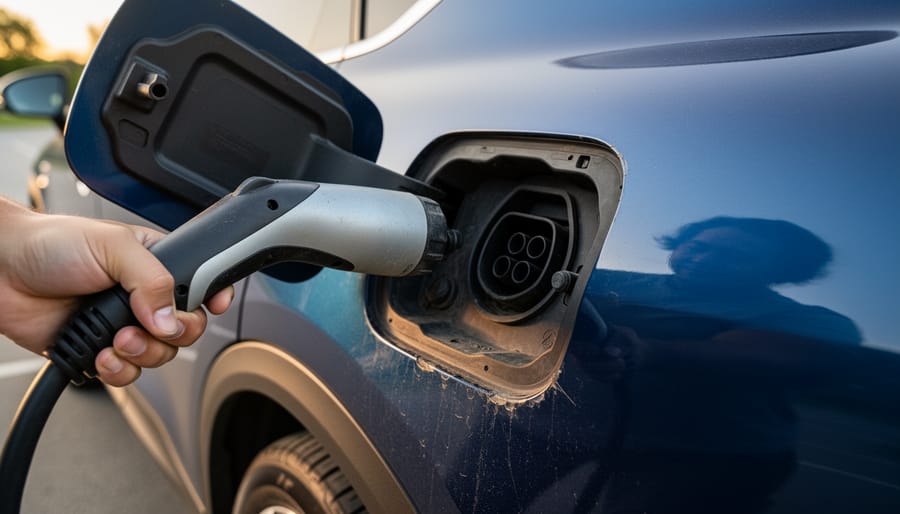
PPF installation around charging ports works in tandem with the charging equipment itself, creating a protective barrier that doesn’t interfere with electrical connections or charging speeds. Modern charging station designs incorporate robust cable management systems that reduce surface contact, but repeated plugging still creates friction points where unprotected paint deteriorates. The thermoplastic urethane in quality PPF maintains a smooth, non-conductive surface that allows charge port doors to operate freely while preventing cable housings from scoring the surrounding bodywork.
For vehicles alternating between home AC charging and public DC fast charging, the protective film encounters different mechanical stresses. AC charging typically involves lighter, more flexible cables that drivers handle daily, creating consistent wear patterns in a small radius around the port. DC fast charging uses heavier, stiffer cables that operators may maneuver less carefully in commercial settings, increasing the risk of impact marks and scuffs. DC monitoring systems at commercial stations help ensure proper connections, but they don’t prevent the physical contact between cables and vehicle surfaces during the plugging process.
PPF’s optical clarity ensures that charge port indicators, LED status lights, and camera systems (on vehicles with charging cameras) remain fully visible through the film. This visibility matters for automated charging systems that rely on visual alignment markers or for drivers confirming proper connection status at night.
Maintenance and Longevity of PPF Around Charging Ports
PPF around your charging port requires minimal effort but strategic care to maintain its protective properties for seven to ten years. Daily charging creates ongoing exposure to dust, moisture, and temperature fluctuations that affect film longevity, making a consistent maintenance routine essential for preserving both appearance and self-healing capabilities.
Establishing a monthly maintenance routine prevents premature degradation and maintains optical clarity. Follow this five-step process for optimal PPF performance:
- Inspect the film edges around the charging port for lifting, discoloration, or trapped debris under the film perimeter.
- Use a microfiber cloth with pH-neutral soap and water to gently clean the PPF surface, avoiding high-pressure washers within six inches of film edges.
- Skip alcohol-based cleaners, petroleum solvents, and abrasive compounds that degrade the urethane polymer structure, opt for cleaning green products specifically formulated for vehicle protective films instead.
- For minor scratches or swirl marks, park in direct sunlight or use a heat gun on low setting (120-140°F) held twelve inches away to activate the self-healing topcoat.
- Schedule professional inspection annually or every 15,000 charging cycles, whichever comes first, to assess adhesion integrity and evaluate replacement timing.
Vehicles charging twice daily in extreme climates (below 20°F or above 95°F consistently) may see reduced film lifespan by 20-30 percent. Winter salt exposure requires immediate washing to prevent crystalline buildup between the film and paint. Summer heat accelerates yellowing in economy-grade films, while premium PPF maintains clarity through temperature extremes.
Replace PPF when you notice persistent haziness that doesn’t clear after cleaning, edge lifting exceeding a quarter-inch, or deep scratches that remain visible after heat activation attempts. Most Tesla and BYD owners find charging port PPF reaches replacement consideration between years six and eight under normal use patterns.
Protecting your Tesla or BYD charging port with PPF represents more than a cosmetic upgrade. It’s a practical commitment to maintaining the long-term value and integrity of your electric vehicle investment. The daily wear from cable insertion, environmental exposure, and repeated contact creates unavoidable stress on factory paint in these high-traffic areas. Left unprotected, this damage accumulates silently until resale inspections reveal the cost of neglect.
PPF offers a straightforward solution that aligns with the broader principles of sustainable EV ownership. By preventing paint deterioration now, you avoid repainting later, which means fewer resources consumed, less waste generated, and better preservation of your vehicle’s original finish. The modest upfront cost of professional charging port protection typically pays for itself through maintained resale value alone.
Whether you choose Tesla or BYD, premium film or economy grade, professional installation or careful DIY application, the essential principle remains consistent. Protecting vulnerable contact points extends your vehicle’s functional lifespan and reduces the environmental footprint of ownership. As charging infrastructure expands and EVs become the transportation standard, these small preventive measures matter more than ever.
Your charging port endures thousands of connections over years of service. Giving it the protection it needs isn’t perfectionism. It’s responsible stewardship of advanced technology designed to last.
